No legal export possible
First description: 
(Günther, 1877) 
Origin of the species name:
The German zoologist Albert Carl Ludwig Gotthilf Günther, then director of the Zoological Department of the Natural History Museum in London (Great Britain), described this species of chameleon in just a few sentences. Unfortunately, he never revealed why he chose the Latin word ‘gallus’, which translates as ‘Gaulish/Gaul’ or ‘rooster’.
Distribution:
Calumma gallus inhabits several rainforests and forest fragments in central to south-central eastern Madagascar, all of which are rarely visited by travellers. These include forest remnants near Tarzanville and Ambatofotsy, the rainforest of Tsinjoarivo in the highlands, and forest fragments near Bac Salehy and Mahanoro directly on the east coast. Mahanoro is, incidentally, the type locality, i.e. the place where the species was first found.
Appearance and size :
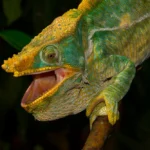
With a total length of 93 mm, this species belongs to the small chameleons. The males have a long, pointed and elastic nasal appendage with a sawtooth-like side view. In females, the nasal appendage is shorter, leaf-shaped and red. The helmet is flat but clearly separated from the back.
Why is there a species page here even though there are no photos?
Until 2025, the extremely similar-looking species Calumma pinocchio from the Vohimana area was considered to be Calumma gallus. Both species differ genetically from each other. Externally, Calumma gallus can be recognised by the sawtooth-like scales on the nasal protuberance of the males, which is completely smooth in Calumma pinocchio. In order to clear up the confusion surrounding the two species, we have left this species page as it is and will add new chameleon photos in due course. We still have some very old images on slides, but they are not really suitable for the internet.
Habitat:
Photos coming soon.
Das könnte dir auch gefallen


Follow us on Instagram

Most popular articles


Your travel specialist for Madagascar