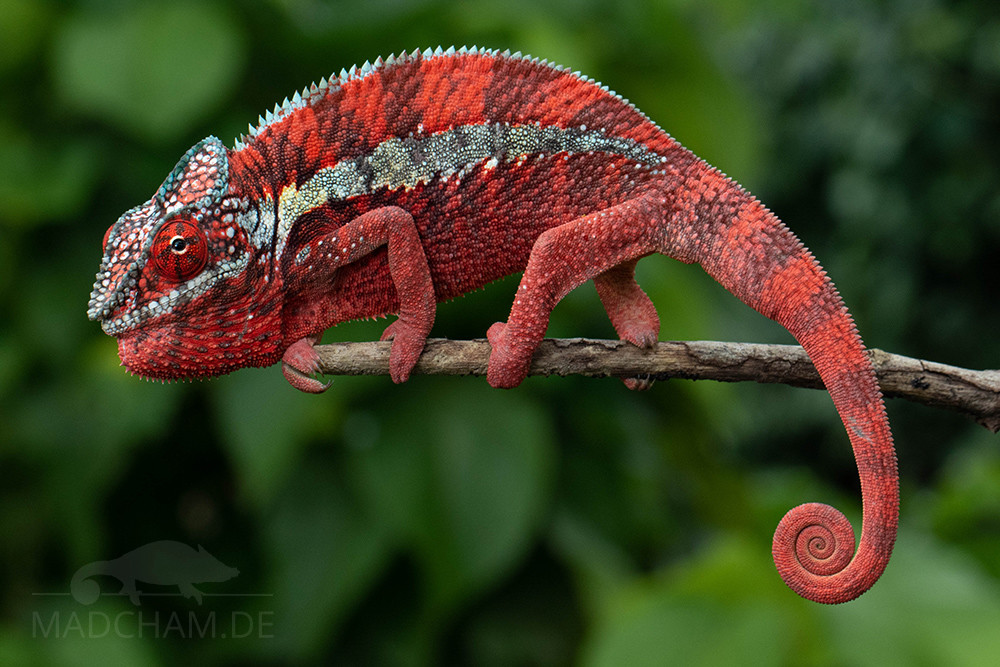
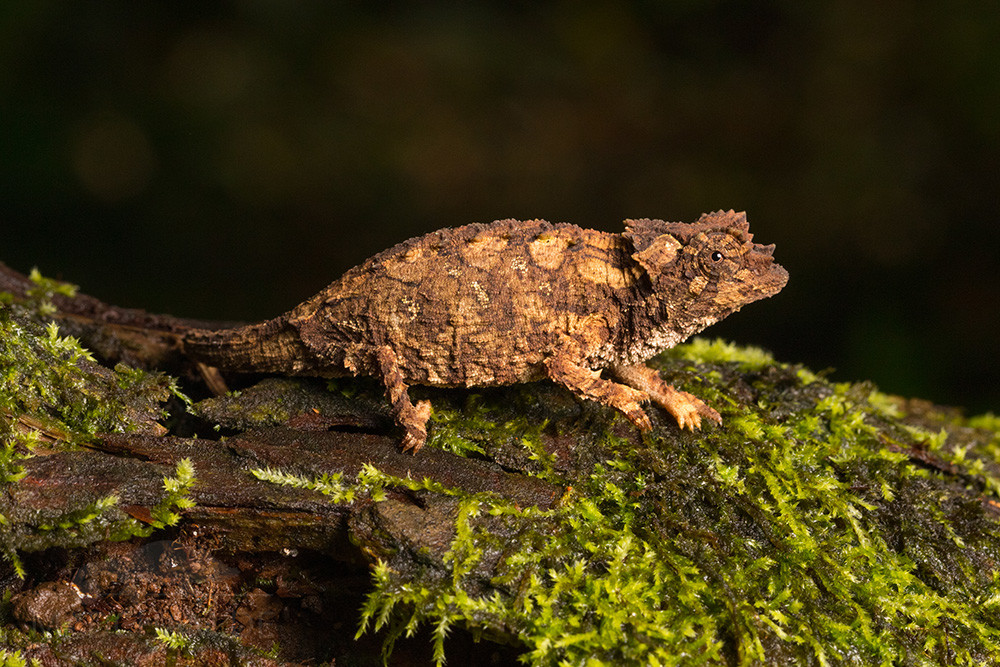
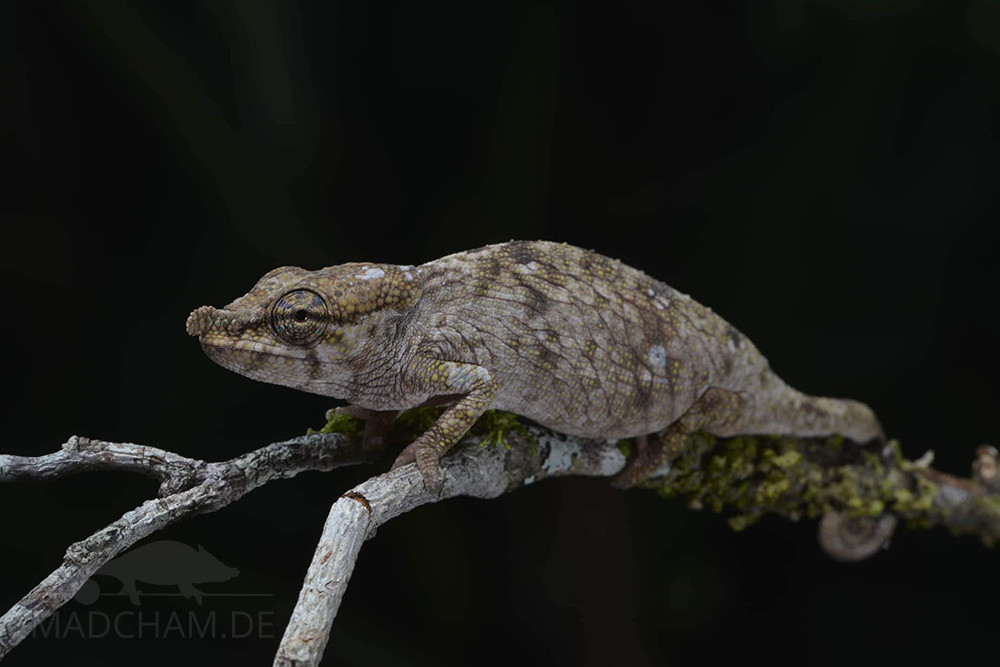
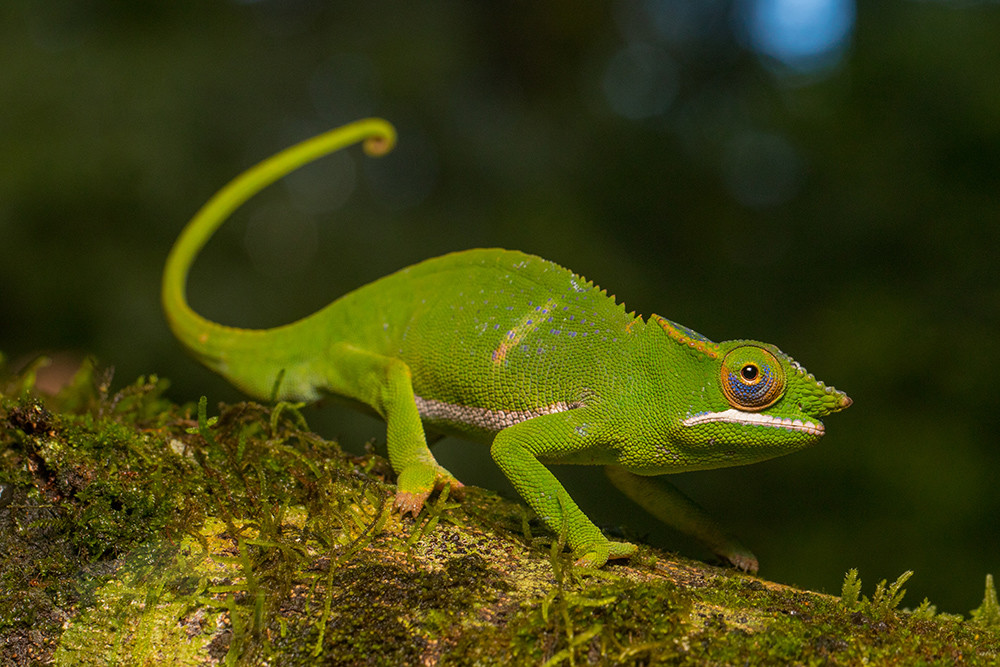
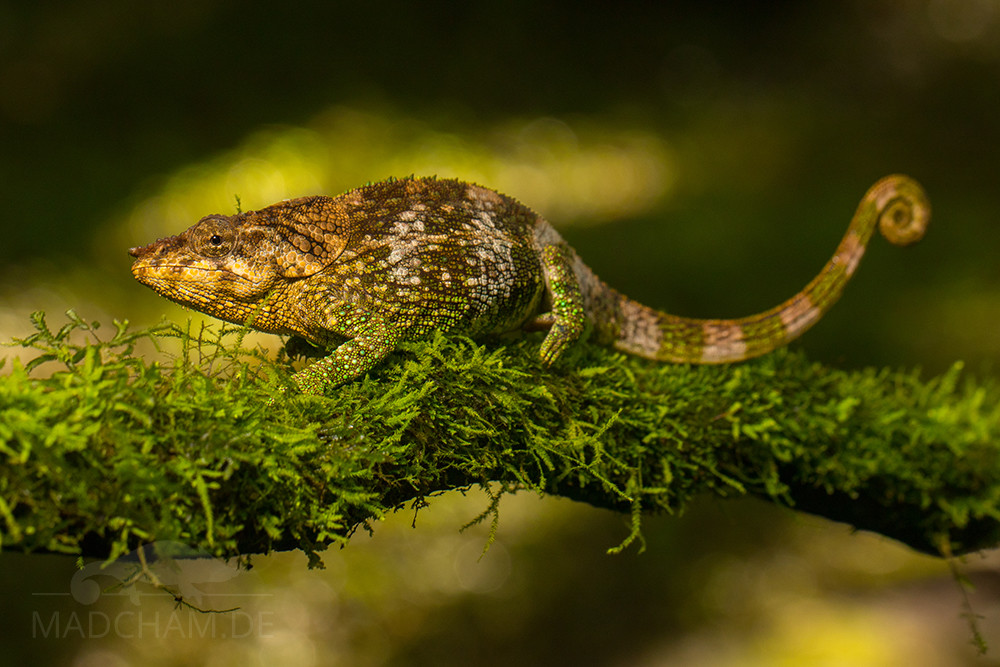
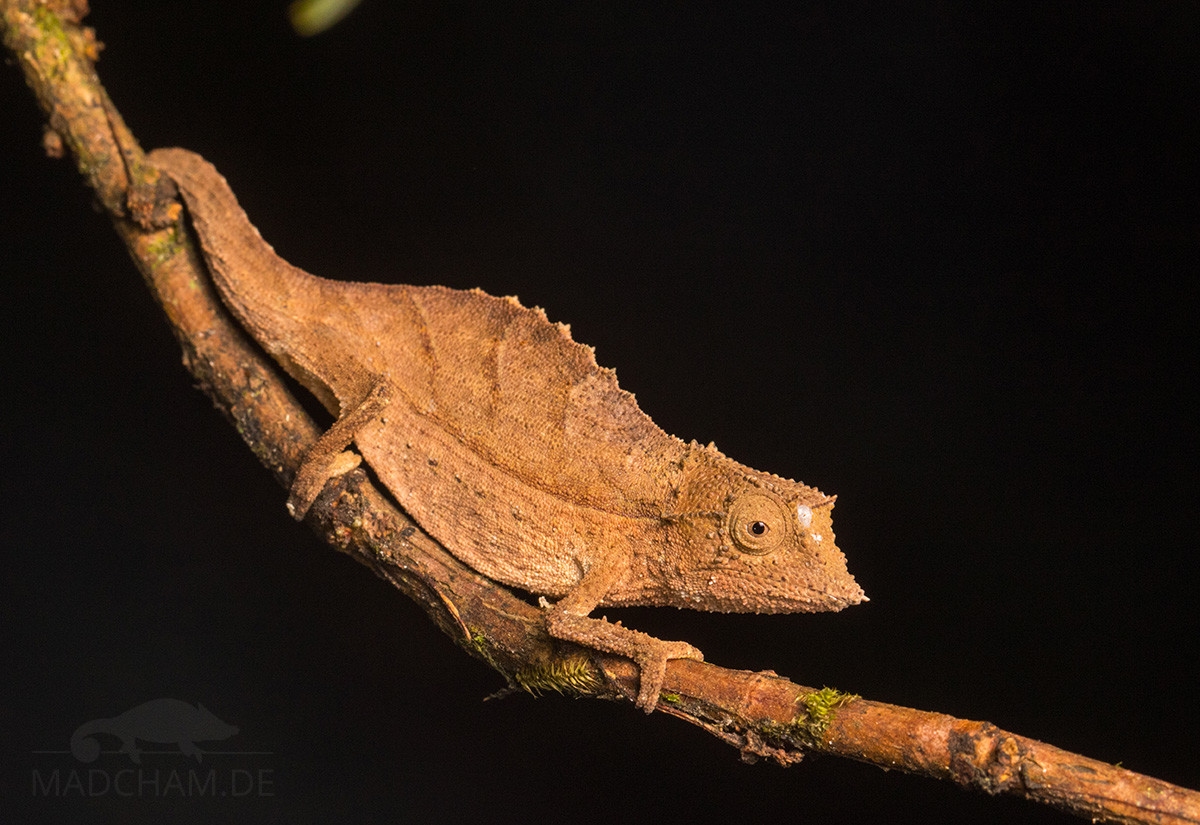
The knowledge about predators of Malagasy chameleons comes mainly from anecdotal reports and so far less systematic research. Also, we observe from time to time how chameleons become victims of other animals in the wilderness of Madagascar. Jenkins, Rabearivony, and Rakotomanana have published the only overview on this topic so far in 2009. We have compiled this article to reflect the current knowledge about the predators of Madagascan chameleons. It can currently be assumed that birds and snakes are the main predators of chameleons in Madagascar.
Birds
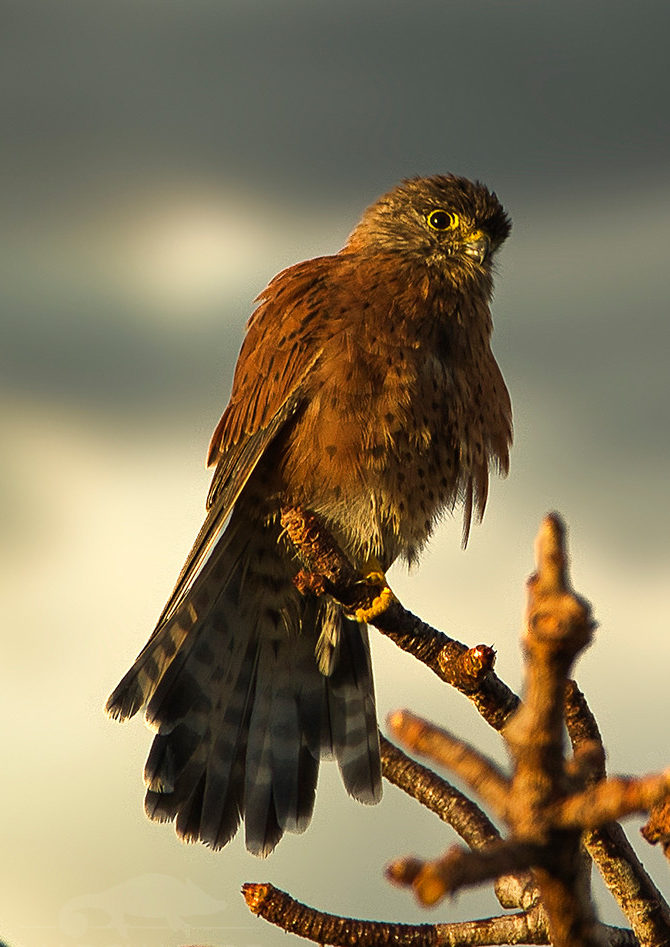
Among the birds, two birds of prey are particularly noteworthy: The Serpent-Eagle (Eutriorchis astur) and the banded kestrel. Chameleons seem to make up a very large part of the diet of these two species. Both hunt mainly in treetops, which predestines chameleons as tree-dwellers for suitable food. In he Serpent-Eagle, it was observed during a breeding time in the rainy season that almost 50% of the prey consisted of chameleons 1Thorstrom Russel, René de Roland Lily-Arison (200): First nest description, breeding behaviour and distribution of the Madagascar Serpent-Eagle Eutriorchis astur. Ibis 142: 217-224. Download. Serpent-Eagles usually sit on a perch and observe the surroundings from there. If they discover worthwhile prey, they fly towards it and grab the prey with their strong claws. Chameleons are usually pierced and killed. With the prey, the Eagles fly back to their perch to eat piece by piece. Mostly decapitated reptiles are brought to the nest for chicks. Madagascar Buzzard (Buteo brachypterus)2Berkelmann, J. (1997): Food habits of the Madagascar buzzard in the rainforest of the Masoala peninsula. The Condor 9: 833-835. Download was observed in Masoala, and around 11% of its prey consisted of chameleons.
In some areas of Madagascar, the banded kestrel (Falco zoniventris) was once thought to be exclusively a chameleon hunter. In the Masoala rainforest, chameleons make up to 50% of the food supply of banded kestrels.3René de Roland, L.-A., Rabearivony, J.R., Razafimanajato,R. H.R., Obenarimangason, H.R., Thorstrom, R. (2005): Breeding biology and diet of the banded kestrel Falco zoniventris on Masoala peninsula. Ostrich 76: 32-36. Download However, observations from other areas of Madagascar suggest that chameleons are only a small part of a very wide range of possible prey for the banded kestrel.4Thorstrom, R. (1999): A description of the nests, diet and behaviour of the banded kestrel. Ostrich 70: 149-151. Download It seems that this bird of prey can feed more on insects, more on chameleons, geckos or more on small birds, depending on availability. Therefore, the banded kestrel is no longer considered a pure chameleon eater today.
The Madagascar buzzard (Buteo brachypterus)5Berkelmann, J. (1997): Food habits of the Madagascar buzzard in the rainforest of the Masoala peninsula. The Condor 9: 833-835. Download was observed in Masoala, and around 11% of its prey consisted of chameleons. An observational study of hook-billed vangas (Vanga curvirostris) in Ankarafantsika in north-western Madagascar found that chameleons made up just over 10% of their prey6Rakotomanana, H., Akamura, M.N., Yamagishi, S. (2001): Breeding ecology of the endemic hook-billed vanga, Vanga curvirostris, in Madagascar. Journal of the Yamashina Institute for Ornithology. 33: 25-35. Download. The parents fed their chicks in the nest with Furcifer oustaleti, Furcifer rhinoceratus and Brookesia decaryi, i.e. all the more common species found in the dry forest there. In addition, the hook-billed vangas fed their chicks many pieces of meat that were unidentifiable to species level, which the authors assume may have included a large proportion of chameleons.
The Madagascar harrier (Circus macrosceles) only uses chameleons in Ambohitantely in the northern highlands as food to a very small extent.7René de Roland, L-A., Rabearivony, J.R., Randriamanga, I, Thorstrom, R. (2004): Nesting biology and diet of the Madagascar harrier (Circus macrosceles) in Ambohitantely Special Reserve, Madagascar. Journal of Raptor Research 38: 256-262. Download The Madagascar harrier-hawk (Polyboroides radiatus) appears to hunt chameleons just as rarely in Berenty in the far south-east of the island. In one study, Furcifer major accounted for only 0.1% of the prey brought to the nest by the breeding partner.8Karpanty, S.M., Goodman, S.M. (1999): Diet of the Madagascar harrier-hawk Polyboroides radiatus in south-eastern Madagascar. Journal of Raptor Research 33: 313-316. Download
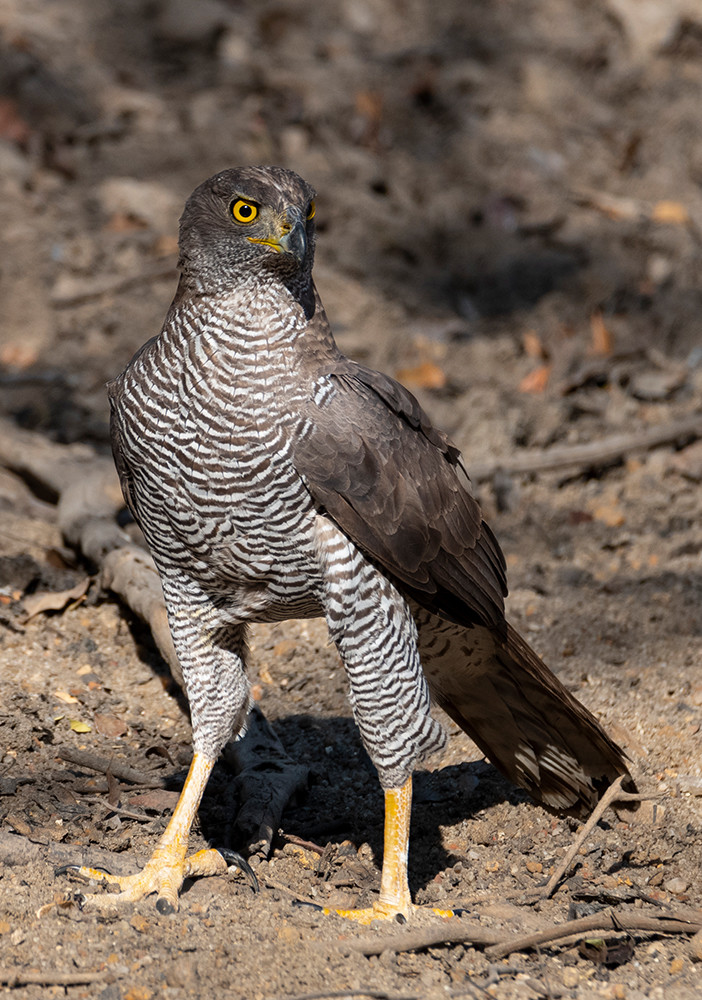
It is strongly suspected that chameleons are potential prey for Frances’ sparrowhawk (Tachyspiza francesii). Studies have shown that up to 42% of its prey consists of reptiles. Whether chameleons are regularly among them has not yet been conclusively determined.

Nocturnal birds rarely seem to catch a chameleon – probably because chameleons sleep at night and are more difficult to spot motionless. Only once have the remains of chameleons been found in the pellets of barn owls (Tyto alba) – even though it occurs in areas that are rich in chameleons. It was probably a young Furcifer verrucosus or Furcifer major that had been caught during the rainy season in Beza-Mahafaly in south-western Madagascar.9Goodman, S.M., Langrand, O.L. (1993): Food habits of the barn owl Tyto alba at three sites on Madagascar. Ostrich 64(4): 160-171. Download
Leaf chameleons are less likely to fall prey to birds. But even these small and inconspicuous chameleons have been attacked and eaten by birds that forage on the ground in the foliage. The short-legged ground roller (Brachypteracias leptosomus) was observed in the Masoala rainforest feeding on around 7% of ground chameleons of the genus Brookesia10Thostrom, R., Lind, J. (1999): First nest description, breeding, ranging and foraging behaviour of the short-legged ground roller Brachypteracias leptosomus in Madagascar. Ibis 141: 569-576. Download. Medium-sized chameleons and their young made up less than 1% of their diet. The scaly ground roller (Geobiastes squamiger) was also observed in Masoala feeding on ground chameleons.11Thostrom, R., Watson, R.T. (1997): Avian inventory and key species of the Masoala peninsula, Madagascar. Bird Conservation International 7: 99-115. Download Both species of ground rollers move mainly on the ground, watching for the slightest movements in the leaf litter. When they spot potential prey, they sprint to the spot and turn over leaves with their beaks until they find it.
Several observations of helmet vangas (Euryceros prevostii) report that, in the same rainforest, leaf chameleons, presumably Brookesia griveaudi, were fed to fledgeling or eaten by adult birds themselves. 12Lamarca, G., Thorstrom, R. (1999): Breeding biology, diet and vocalization of the helmet vanga, Euryceros prevostii, on the Masoala Peninsula, Madagascar. Ostrich 71: 400-403. Download13Thostrom, R., Watson, R.T. (1997): Avian inventory and key species of the Masoala peninsula, Madagascar. Bird Conservation International 7: 99-115. Download Overall, however, chameleons accounted for only slightly more than 1% of the diet of the helmet vangas observed – the most commonly preyed upon food source was insects.
Snakes
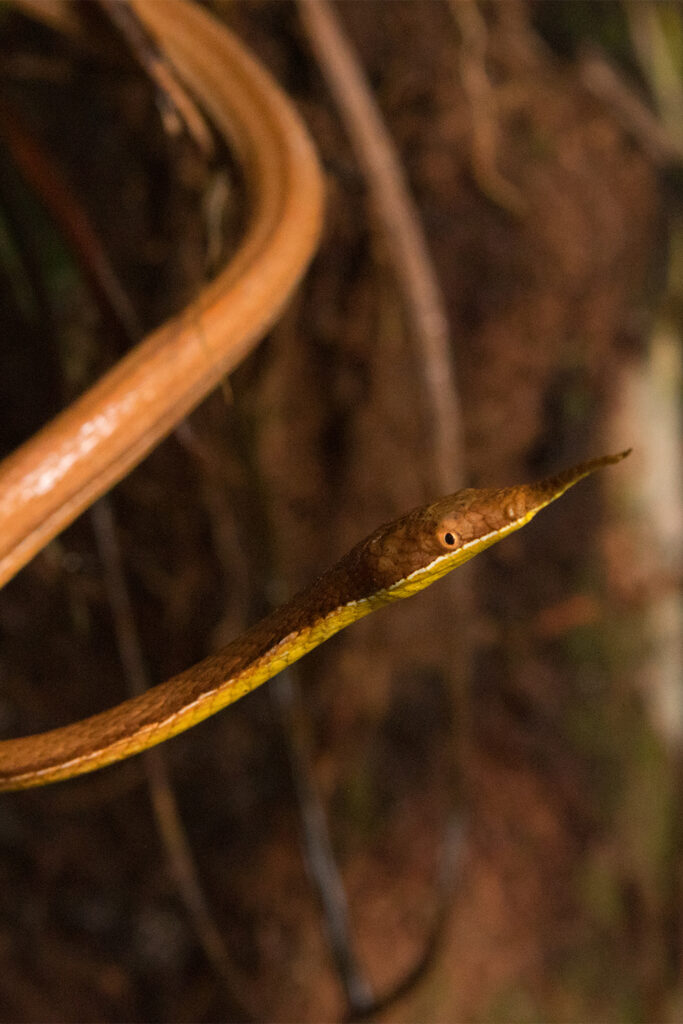
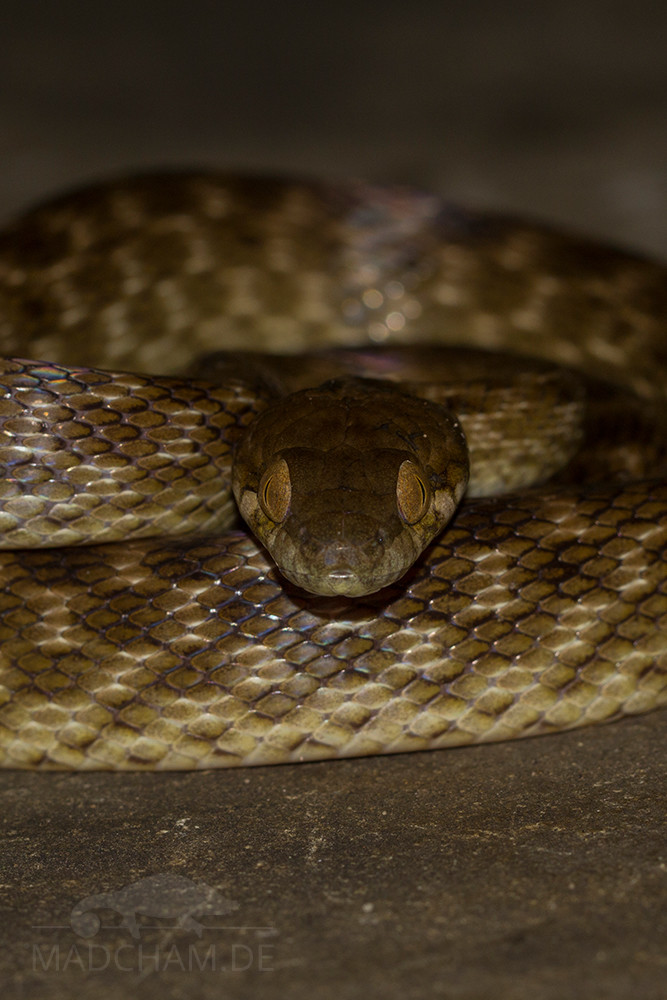
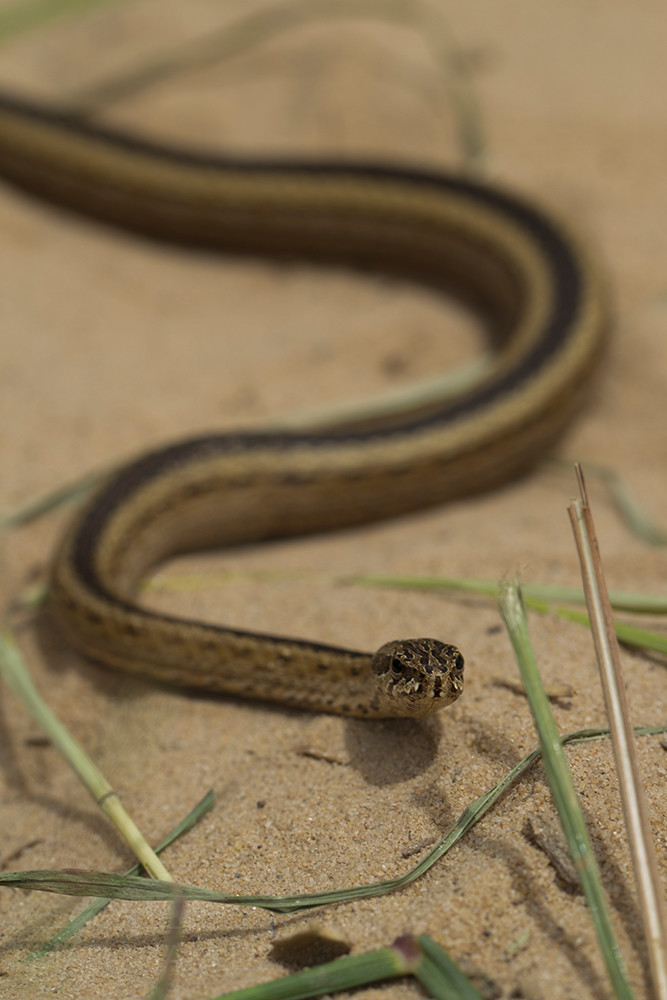
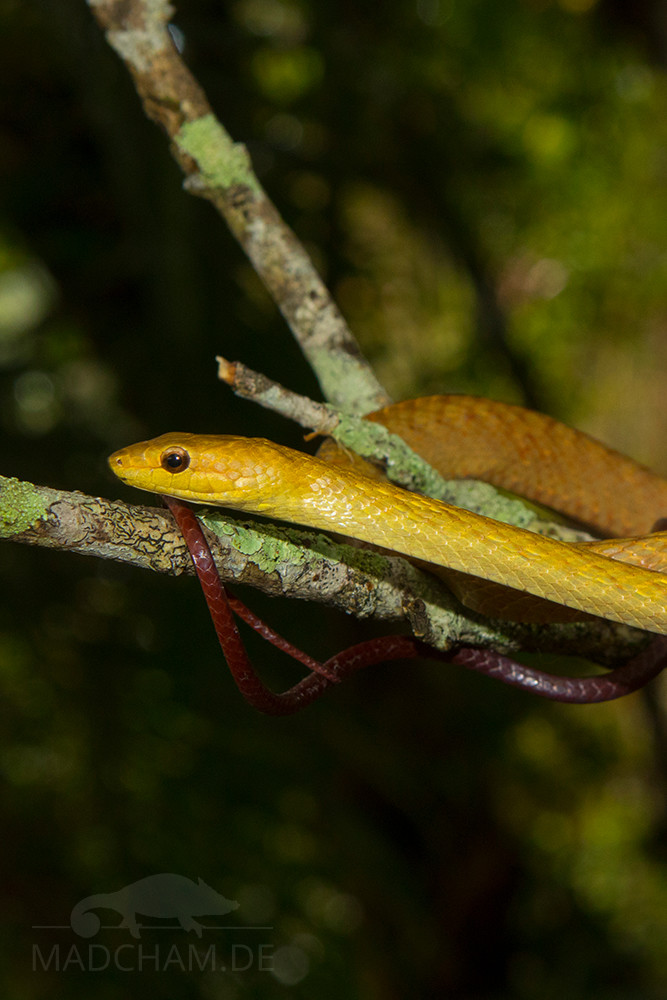
The most common chameleon eaters are the Common Big-Eyed Snake (Mimophis mahfalensis), Ithycyphus perineti or Ithycyphus oursi and Madagascarophis colubrinus. All four species find chameleons directly in trees and on the ground. But the leaf-nosed snake (Langaha madagascariensis) has also been documented to have eaten Furcifer verrucosus. Chameleons are also a regular part of the diet of various snakes of the genus Phisalixella (formerly Stenophis) and Parastenophis (Ph. variabilis, Pa. betsileanus). For example, a Parastenophis betsileanus was preserved for scientific study in Andasibe, which had a Furcifer willsii in its stomach.14Raxworthy, C.J. (1988): Reptiles, rainforest and conservation in Madagascar. Biological Conservation 43: 181-211. Download.

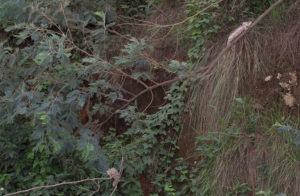
This Furcifer oustaleti has unfortunately just fallen victim to a snake
All the snakes mentioned kill their victims with a bite, while secretion from the so-called Duvernoy glands runs into the wound. The Duvernoy glands are a kind of “primitive precursor” of real venom glands. The poison produced in these glands is not particularly potent. In Common Big-Eyed snakes, Phisalixella and Parastenophis, it is released through fangs that are located far back in the jaw, approximately under the eyes. For large mammals such as humans, the venom of the Malagasy colubrids is rather harmless and can be compared to a wasp sting. Chameleons, however, may be paralyzed by the effect of the secretion and even be killed. As far as has been investigated so far, the poison is a haemotoxin, which means it destroys blood cells. Madagascar is also home to several constrictor snakes, but they seem to care less about chameleons than about other prey.
We have already observed several times that snakes killed or strangled chameleons by bite, but could not swallow them because of their size. It seems that every now and then chameleons become victims of snakes that simply overestimate their abilities.
But the dead chameleons do not remain lying around for long – they are broken down into smaller pieces and decimated by insects, birds, or other reptiles quite quickly. By the way, picture on the right above shows exactly such a situation: A Phisalixella variabilis entangled a Furcifer oustaleti and killed it with a bite near its head. After the chameleon was dead, the snake tried to devour it. After a good half hour, it stopped, because the chameleon simply did not fit between the jaws. The next day, all that was left of the body of the Furcifer oustaleti were single bones and some skin – the “ground police” of the dry forest had done a great job.
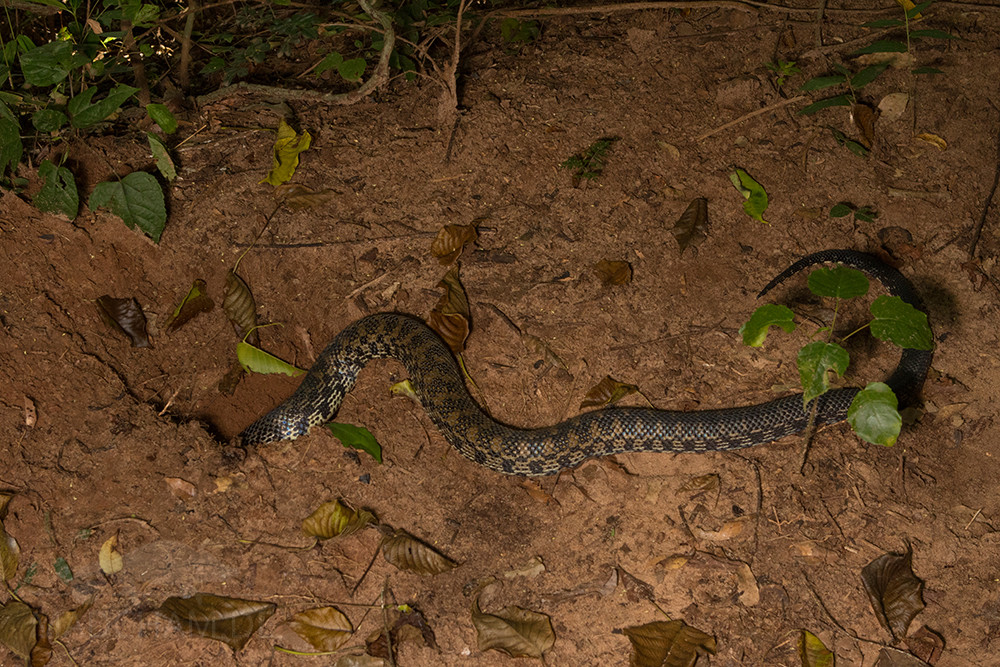
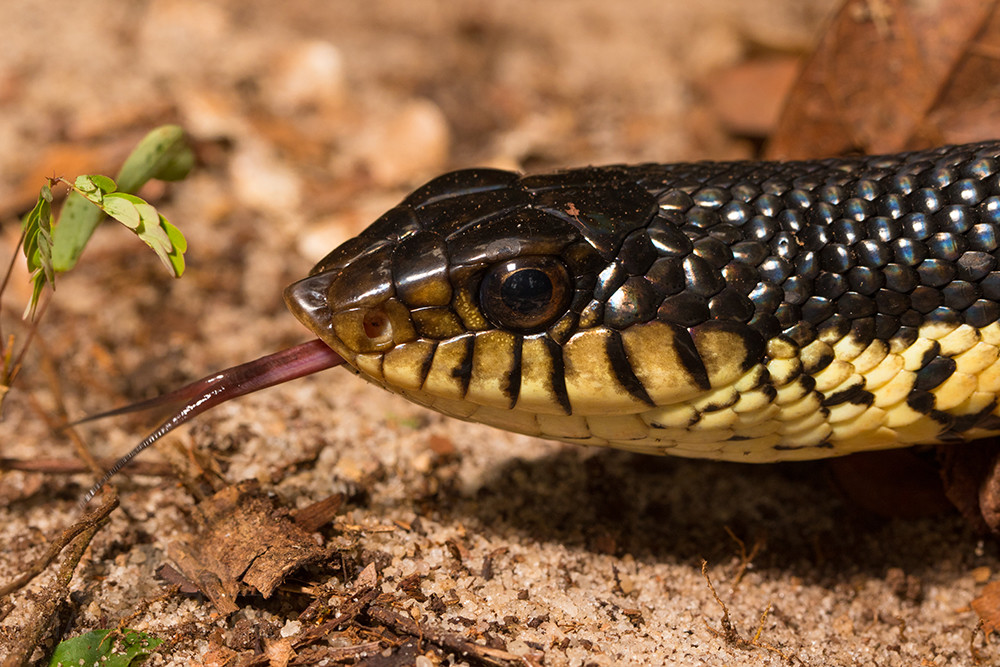
Some snakes simply eat what they can find – preferably eggs buried in the ground, and now and then a live chameleon. Among these snakes are the Malagasy Giant Hognose Snake (Leioheterodon madagascariensis) and Pseudoxyrophus ambreensis. They burrow headfirst into the sand or the ground to find fresh clutches. In the photo, a Hognose Snake has apparently just found a chameleon clutch in the dry forest of Ankarafantsika. The eggs are slit in the mouth with the teeth so that the yolk and yolk can be digested. The eggs of chameleons in the ground are generally susceptible to predators. These do not even have to be snakes. Even certain species of ants can destroy chameleon eggs.
Frogs
It is interesting that even frogs rarely eat chameleons in the rainy season. In particularly rainy years, hatchlings may end up in the stomach of the grass frog (Ptychadena madagascariensis) or Mantidactylus femoralis. Probably other frogs also reach for chameleon hatchlings when they get the chance – but it has been observed very rarely so far. Very small chameleons are also occasionally captured by praying mantises and large spiders.
Lemurs, Fossa and smaller mammals
Lemurs also rarely eat chameleons – probably only when a very good opportunity arises. Ring-tailed lemurs, mouse lemurs, and fat-tailed dwarf lemurs have been observed to eat chameleons. Actually these lemurs prefer fruits, flowers, and leaves. Mouse lemurs and fat-tailed dwarf lemurs supplement their diet with insects. In the dry season, however, the supply of fresh greenery and insects is rather limited in the southern parts of Madagascar. A chameleon is then just the right “stopgap”.
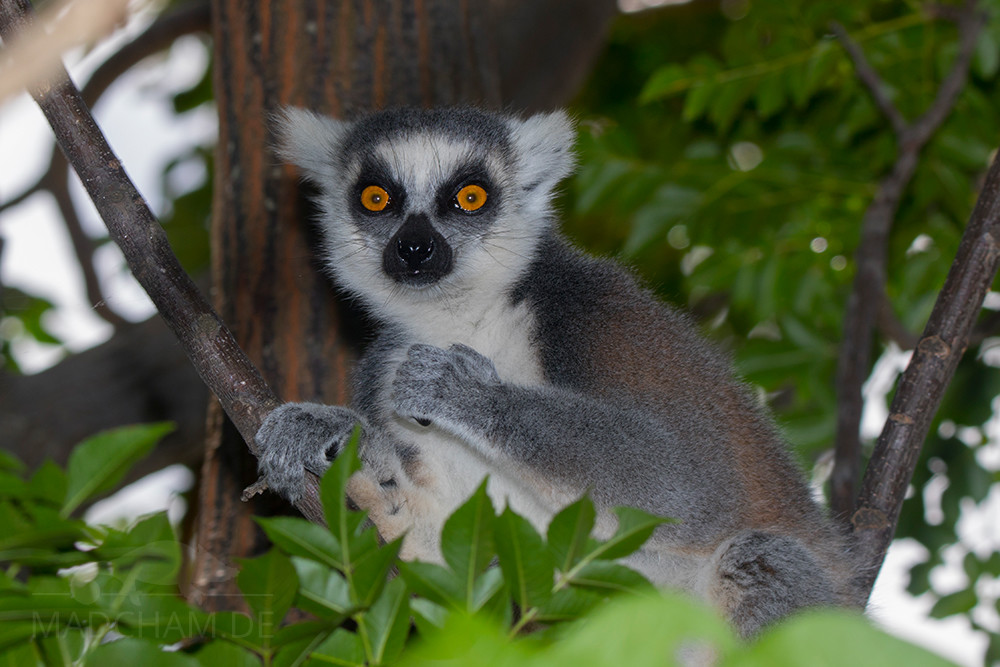
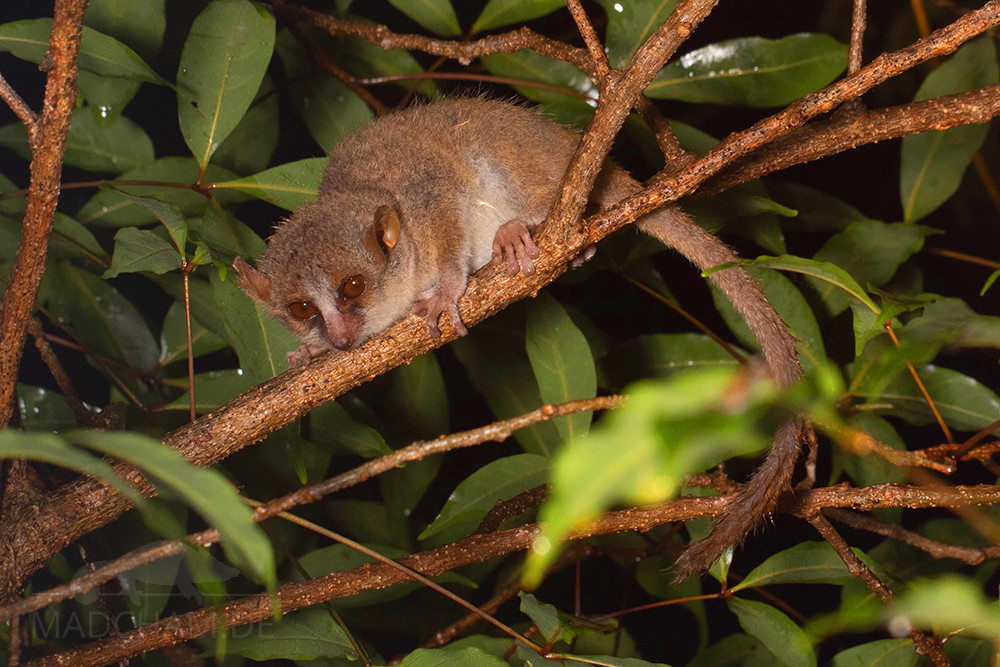

It is striking that lemurs often left a large part of their unusual prey unused during observations. This suggests that chameleons are neither a main meal nor a particularly common prey for lemurs. Perhaps chameleons simply do not appeal to lemurs. However, it is also possible that lemurs kill chameleons more out of curiosity and for “trial and error” than out of hunger.

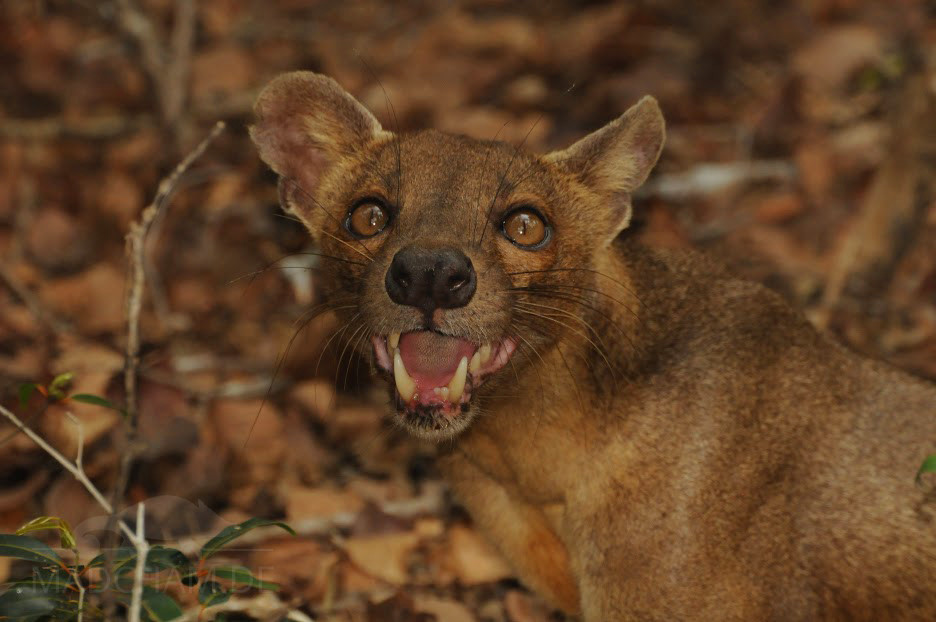

Another Malagasy mammal that occasionally makes use of the chameleon population is the approximately knee-high Fossa, the largest predator on the island. Fossas are cathemeral, i.e. active during the day and/or night, depending on their needs. They can easily climb trees and find chameleons there. Opportunistic hunters such as the ring-tailed mongoose (Galidia elegans), Grandidier’s mongoose (Galidictis grandidieri), the Fanaloka (Fossa fossana) or various species of tenrecs do not spurn a chameleon from time to time either. Tenrecs mainly browse in foliage, so their victims are mainly leaf chameleons.
Invasive species: Cats and Norway rats
Introduced domestic cats and Norway rats are also an increasing threat to chameleons in Madagascar. Norway rats are not only displacing the native rats endemic to Madagascar. They also feed opportunistically on anything they can overpower and eat. As far as chameleons are concerned, Norway rats mainly feed on the eggs, which they dig up, eat and destroy.
Cats are often fed even by the poorest Madagascans but are not neutered, which is why they reproduce uncontrolled on the island. We have already been told by several Madagascans that cats sometimes even “specialize” in digging chameleon females and specifically search the ground for egg-laying chameleons in order to kill them. We have seen cats successfully hunt and kill panther chameleons and other common species on several occasions. Cats do not only help themselves to ‘unwanted’ rats and mice in houses. They are very successful at killing amphibians, reptiles and birds.
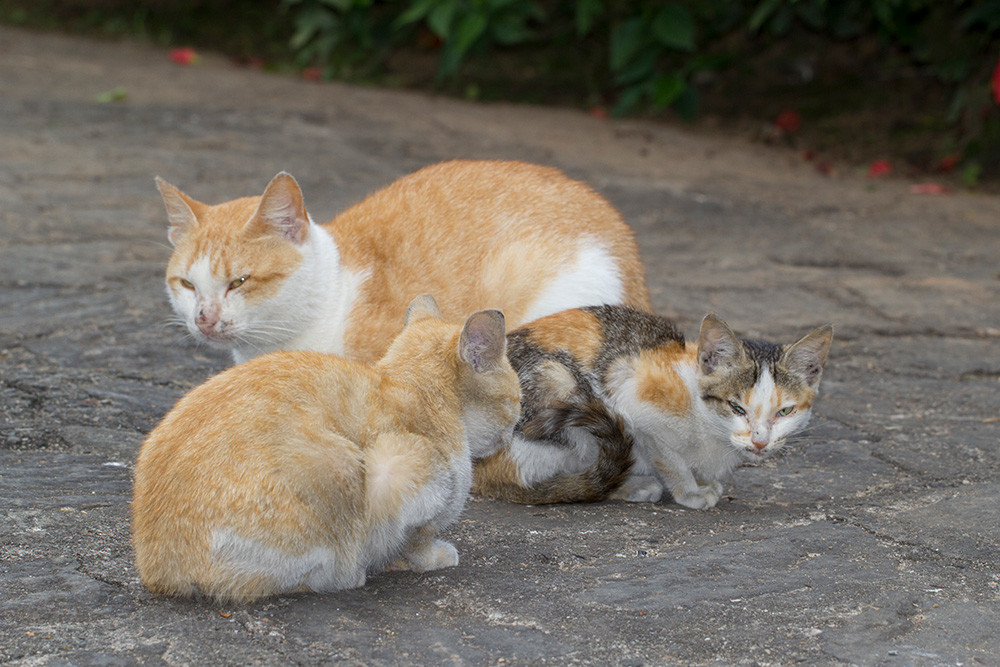


Cats are, therefore, unfortunately, an increasing problem factor for the native species diversity in Madagascar. The following photos were taken in Andasibe, Ambilobe, and Sambava. We would have hundreds more. Even in the most remote regions of Madagascar, stray domestic cats have become native. Rats mainly prey on eggs, which they dig up, eat, and destroy.
Humans
By the way, although humans are not “real” predators, they are the biggest problem for chameleons in Madagascar. Many chameleons are losing their habitat due to slash-and-burn agriculture and logging by human hands. Not all species are able to survive in secondary vegetation without problems. Many Malagasy chameleon species depend on special habitats such as intact rainforest at a certain altitude or intact spiny forest.
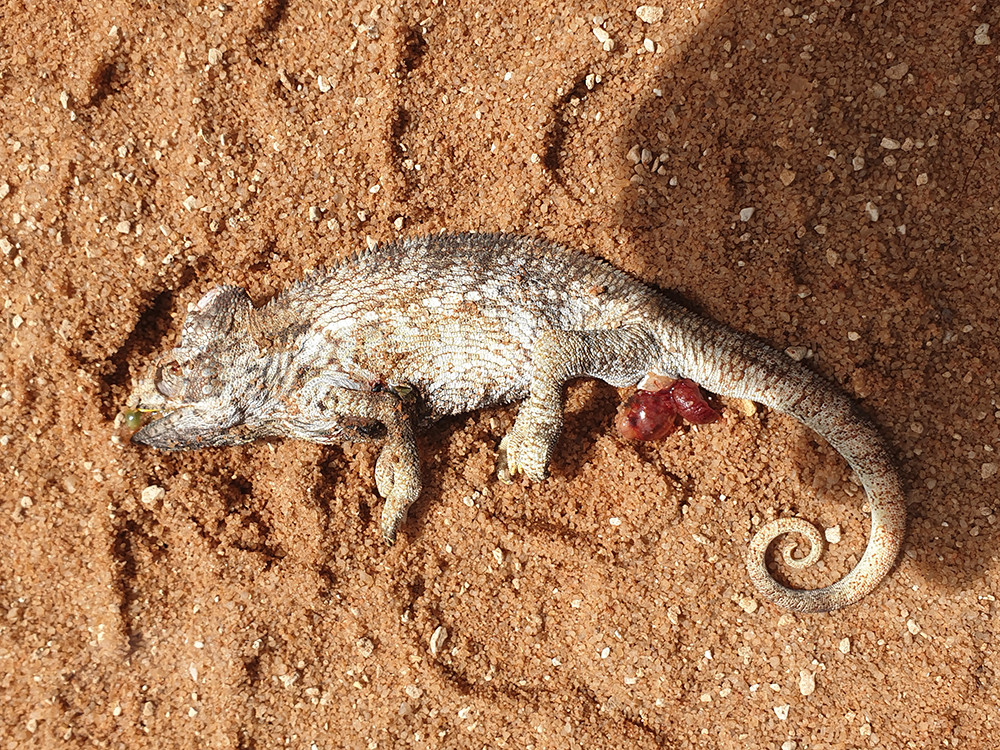
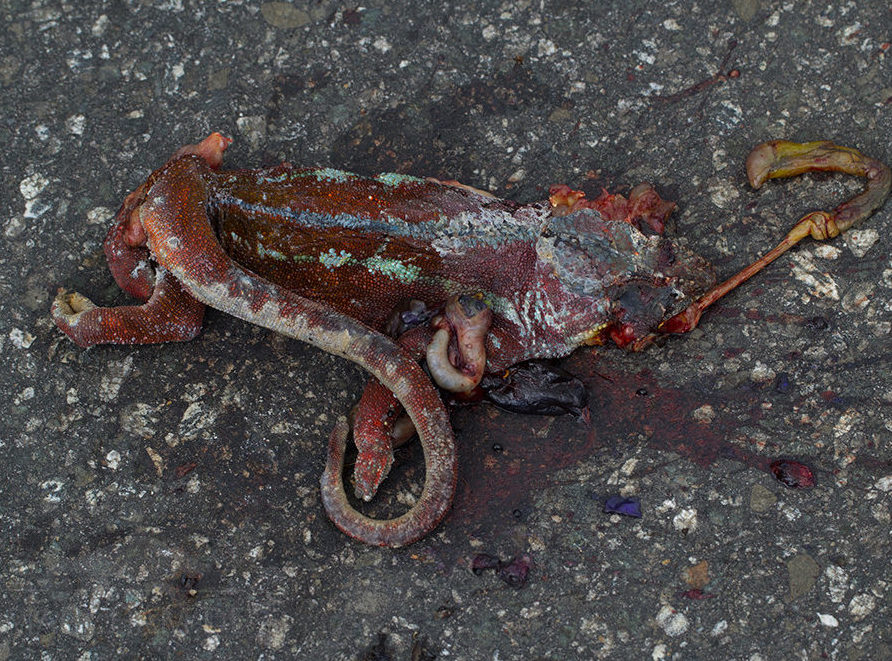
Man has been destroying these chameleon habitats in Madagascar for many decades. Even designated protected areas are threatened with destruction because of the high and almost unstoppable poverty on Madagascar. And humans also kill by moving around: chameleons are regularly run over on Madagascar’s roads. Even though these are usually not rare species, the affected chameleons have died unnecessarily.

Literatur zu diesem Thema
- 1Thorstrom Russel, René de Roland Lily-Arison (200): First nest description, breeding behaviour and distribution of the Madagascar Serpent-Eagle Eutriorchis astur. Ibis 142: 217-224. Download
- 2Berkelmann, J. (1997): Food habits of the Madagascar buzzard in the rainforest of the Masoala peninsula. The Condor 9: 833-835. Download
- 3René de Roland, L.-A., Rabearivony, J.R., Razafimanajato,R. H.R., Obenarimangason, H.R., Thorstrom, R. (2005): Breeding biology and diet of the banded kestrel Falco zoniventris on Masoala peninsula. Ostrich 76: 32-36. Download
- 4Thorstrom, R. (1999): A description of the nests, diet and behaviour of the banded kestrel. Ostrich 70: 149-151. Download
- 5Berkelmann, J. (1997): Food habits of the Madagascar buzzard in the rainforest of the Masoala peninsula. The Condor 9: 833-835. Download
- 6Rakotomanana, H., Akamura, M.N., Yamagishi, S. (2001): Breeding ecology of the endemic hook-billed vanga, Vanga curvirostris, in Madagascar. Journal of the Yamashina Institute for Ornithology. 33: 25-35. Download
- 7René de Roland, L-A., Rabearivony, J.R., Randriamanga, I, Thorstrom, R. (2004): Nesting biology and diet of the Madagascar harrier (Circus macrosceles) in Ambohitantely Special Reserve, Madagascar. Journal of Raptor Research 38: 256-262. Download
- 8Karpanty, S.M., Goodman, S.M. (1999): Diet of the Madagascar harrier-hawk Polyboroides radiatus in south-eastern Madagascar. Journal of Raptor Research 33: 313-316. Download
- 9Goodman, S.M., Langrand, O.L. (1993): Food habits of the barn owl Tyto alba at three sites on Madagascar. Ostrich 64(4): 160-171. Download
- 10Thostrom, R., Lind, J. (1999): First nest description, breeding, ranging and foraging behaviour of the short-legged ground roller Brachypteracias leptosomus in Madagascar. Ibis 141: 569-576. Download
- 11Thostrom, R., Watson, R.T. (1997): Avian inventory and key species of the Masoala peninsula, Madagascar. Bird Conservation International 7: 99-115. Download
- 12Lamarca, G., Thorstrom, R. (1999): Breeding biology, diet and vocalization of the helmet vanga, Euryceros prevostii, on the Masoala Peninsula, Madagascar. Ostrich 71: 400-403. Download
- 13Thostrom, R., Watson, R.T. (1997): Avian inventory and key species of the Masoala peninsula, Madagascar. Bird Conservation International 7: 99-115. Download
- 14Raxworthy, C.J. (1988): Reptiles, rainforest and conservation in Madagascar. Biological Conservation 43: 181-211. Download
Das könnte dir auch gefallen



Follow us on Instagram

Most popular articles


Your travel specialist for Madagascar